
McDonald’s Energy Monitoring
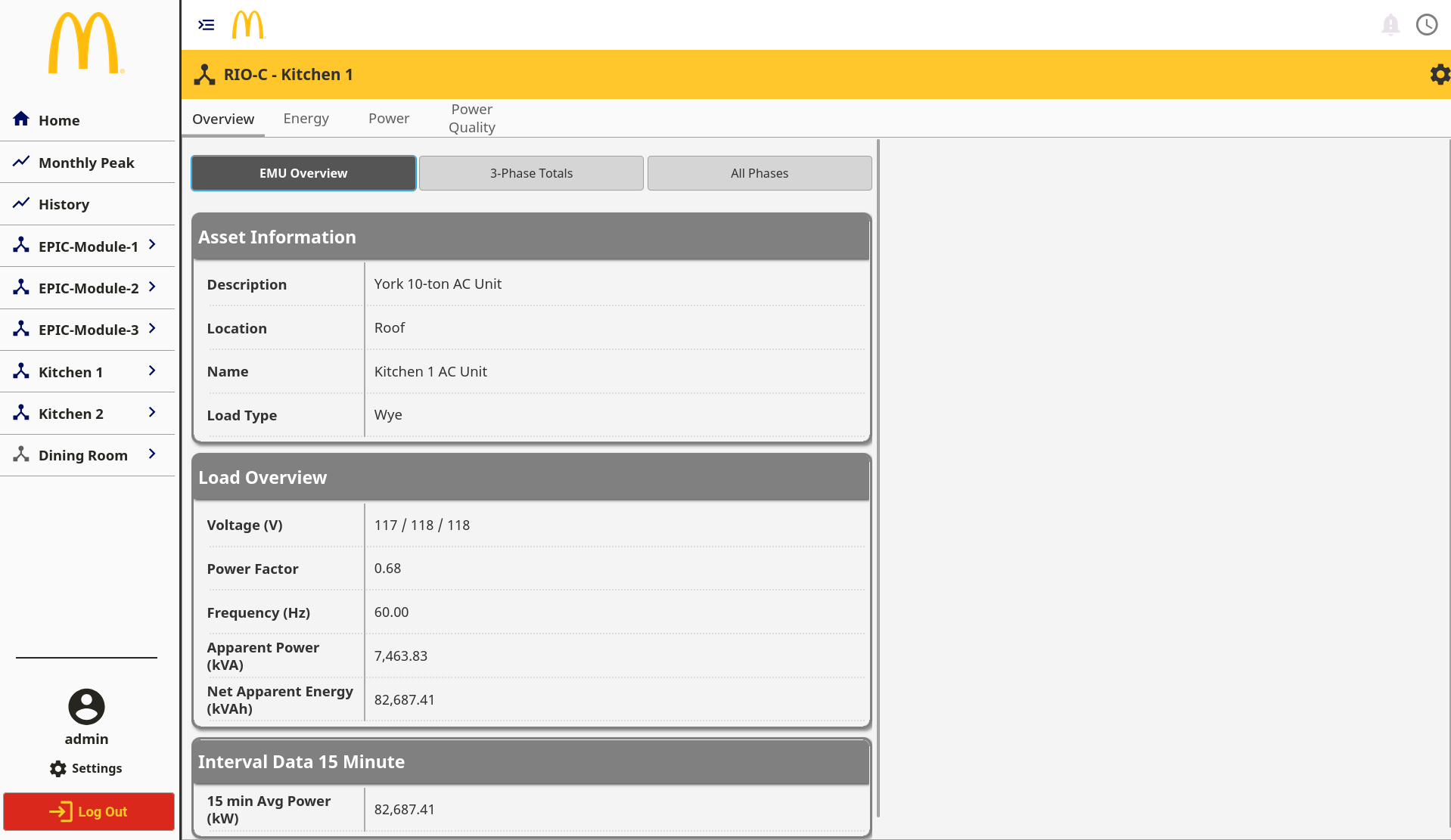
Through our on going work with the team at Opto 22, specifically with their groov RIO Energy Monitoring Unit (EMU) hardware, Corso Systems was tasked with helping the owner of a number of McDonald’s franchises in Southern California better understand their overall energy usage.
Process
A McDonald’s restaurant uses a lot of energy and not only for their kitchen equipment. Depending on the climate they may have a large energy bill due to their HVAC systems, and surprisingly can also incur a high cost with parking lot and exterior lighting.
The owner of a number of McDonald’s franchises in Southern CA wanted to better understand where his energy dollars were going across his restaurants. After looking at a number of power conditioning options he decided to work with the team at Opto 22 to use their powerful groov RIO EMU units to quickly get an energy monitoring system set up.
Since we have worked with Opto 22 on a number of initiatives over the years to open source our groov RIO EMU faceplates on the Ignition Exchange, they reached out to us to help!
Solution
Our solution was simple, build out the groov RIO EMU faceplates along with some more advanced tools from the State of Indiana Energy IN-Sightsprogram to quickly roll out a scalable energy monitoring system.
The system was hosted on a cloud-based Ignition SCADA server, accessible from anywhere on mobile devices.
In addition to energy monitoring, we incorporated some additional functionality to help lower HVAC and exterior lighting costs.
Since the EMU does not provide control capability and integrating directly with the HVACand exterior lighting systems was beyond the scope of this project we took a novel approach.
We could read the HVAC system’s energy usage and based on some work with the McDonald’s staff we correlated usage with temperature setpoints inside the restaurant. We tied into the National Weather Service’s weather API to pull in the current weather conditions, and based on the HVAC’s energy usage and the current outdoor temperature and solar intensity set the system up to generate alerts to signal the manager to adjust the thermostat accordingly.
We also set up alerts if the exterior lights were running during daylight hours as there is no need to light up the parking lot when the sun is shining.
Result
These 2 simple additions helped the owner better understand and reign in his utility costs across his restaurants and quickly paid for the cost of the additional hardware, improving his overall profitability after 2 months.
This project helped the owner’s sustainability leadership across McDonald’s owners, while also reducing his energy costs and improving profitability of his restaurants.